
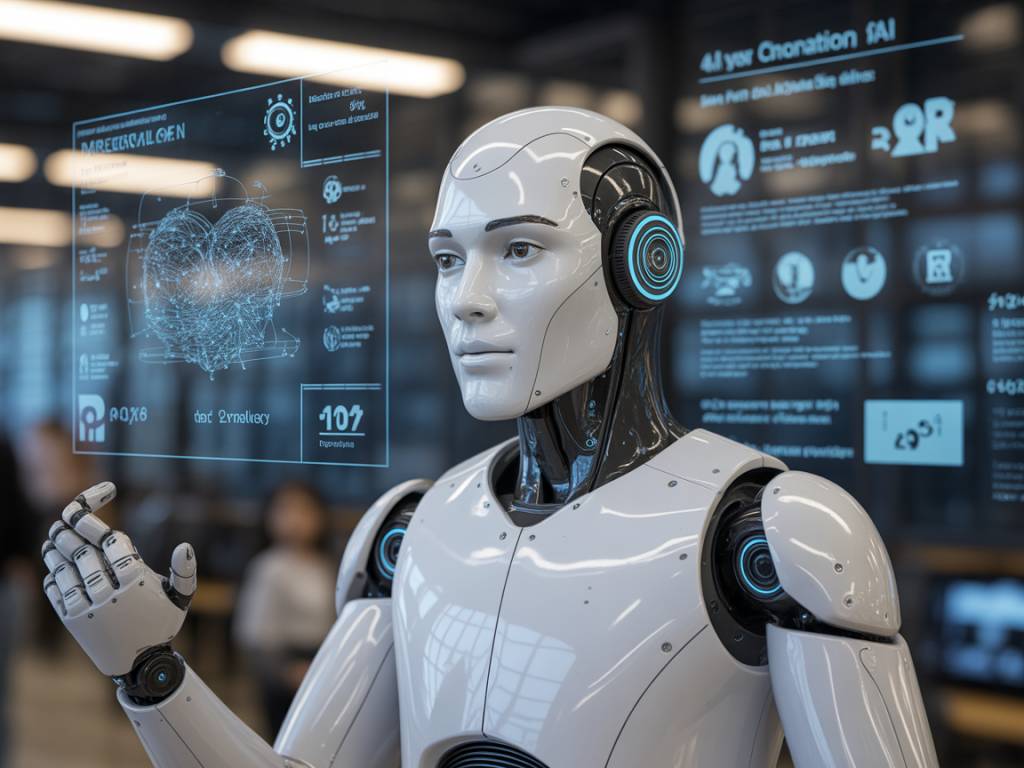
The rise of generative AI agents in marketing automation
By 2026, marketing automation will be defined less by static workflows and more by autonomous, generative AI agents capable of learning, reasoning and acting across channels. These AI-powered agents will not simply trigger emails based on pre-set rules; they will continuously analyze customer signals, generate content in real time, and orchestrate entire customer journeys with minimal human intervention.
Generative AI agents differ from traditional marketing automation tools in three essential ways. First, they are goal-driven: marketers define objectives (such as lead quality, lifetime value, or retention), and the agents work backward to optimize paths to those goals. Second, they are adaptive: rather than relying on fixed workflows, they update strategies based on new data and outcomes. Third, they are generative: they create copy, images, offers, and journey variants dynamically, instead of selecting from a limited library of assets.
As companies move from template-based email campaigns and rigid funnels to intelligent, real-time orchestration, generative AI agents will become the connective tissue between CRM systems, customer data platforms (CDPs), and marketing execution tools. This will fundamentally reshape how brands design, manage and optimize customer journeys.
From static funnels to dynamic, agent-driven customer journeys
Most customer journeys today are designed as linear or branching funnels: awareness, consideration, conversion, and loyalty. In 2026, generative AI agents will turn these static funnels into dynamic, personalized journeys that evolve at the pace of the customer, not the marketer’s planning cycle.
Instead of mapping a single “ideal” journey, marketers will define broader journey intents. For example:
- Nurture first-time visitors into qualified leads within 30 days
- Reduce churn risk among subscribers by 20% over one quarter
- Increase cross-sell adoption of a complementary product line
AI agents will then interpret these intents and orchestrate micro-journeys on an individual basis. The journey for each customer will be generated in real time based on behavioral data, preferences, context, and predictive scores. Messages, channels, timing, and offers will adapt continuously as the agent learns what works for that specific profile.
This shift will make customer journey orchestration far less dependent on manual segmentation and hypothesis-driven A/B tests. Journeys will look more like living systems, where thousands of micro-decisions—drafted, tested, and refined by AI—replace the rigid sequences that dominate marketing automation today.
How generative AI agents will reshape core marketing automation workflows
Generative AI agents will embed themselves into every layer of modern marketing stacks. Their impact will be particularly visible across several core workflows.
Lead scoring and qualification
Predictive lead scoring has been around for years, but generative agents will expand it into continuous, multi-signal qualification. Instead of static scores based on firmographic and engagement data, agents will synthesize:
- Real-time behavioral intent signals (site navigation paths, content depth, interaction frequency)
- Product usage telemetry in SaaS and app environments
- Conversation transcripts from chat, email, and sales calls
- External data such as reviews, social signals, or partner insights
Agents will then automatically generate tailored outreach sequences, handoff notes for sales, and contextual content for each stage of the buying process. Marketing automation will feel less like a scoring model and more like a continuously learning advisor orchestrating the next best action.
Content generation and personalization at scale
In 2026, generative AI content will move from “helpful assistant” to fully integrated content engine. AI agents will be authorized to create and deploy campaign assets within guardrails defined by brand, compliance, and performance targets.
For every customer segment—or even every individual—agents will be able to generate:
- Personalized email sequences tailored to prior engagement and predicted intent
- Dynamic landing page copy that adjusts headlines, proof points, and CTAs
- Localized ads and social posts adapted to culture, language, and device
- In-product messages aligned with specific usage patterns and feature adoption goals
Crucially, these agents will not only generate content, but also evaluate its performance across channels and iterate automatically. Underperforming variants will be replaced in near real time, and winning ideas will propagate across campaigns, creating a self-optimizing content ecosystem.
Cross-channel orchestration and timing
Modern customer journeys already span email, SMS, push notifications, paid media, chatbots, and in-product messaging. By 2026, generative AI agents will act as central coordinators, deciding which channel to use, how often to engage, and at what moment to intervene for each user.
Instead of static cadence rules (e.g., “two emails per week, one push per month”), agents will calculate channel pressure and engagement thresholds individually. They will factor in:
- Customer channel preferences and historical responsiveness
- Time zone, device usage patterns, and typical decision windows
- Sensitivity to frequency and tolerance for interruptions
- Compliance and consent levels for each communication type
The result will be less noise and more relevance. Well-orchestrated journeys will feel less like campaigns and more like helpful, context-aware assistive experiences.
AI agents as co-pilots for marketers, not replacements
The rise of autonomous agents raises legitimate questions about the role of human marketers. In practice, teams in 2026 are likely to rely on a hybrid operating model where AI agents serve as strategic and operational co-pilots rather than full replacements.
Marketers will shift their focus to:
- Defining objectives, constraints, and ethical guidelines for AI agents
- Shaping brand voice, positioning, and overarching narrative arcs
- Designing experimental frameworks at a high level, then letting agents iterate
- Monitoring performance, diagnosing anomalies, and interpreting insights
- Collaborating with sales, product, and customer success teams on integrated journeys
In this model, AI handles the high-frequency, data-heavy, and repetitive tasks that historically consumed large portions of marketing calendars. Human teams will remain essential for creative direction, strategic prioritization, governance, and cross-functional alignment.
Data, privacy, and governance as competitive differentiators
Generative AI agents are only as effective as the data they can access and the guardrails that shape their behavior. By 2026, leading organizations will treat data quality and governance not simply as compliance obligations but as central components of their marketing strategy.
To fully leverage AI-driven marketing automation and customer journey optimization, brands will need:
- A unified, privacy-safe customer data foundation across CRM, CDP, analytics, and product systems
- Consent-aware identity resolution to avoid over-personalization or regulatory risks
- Clear policies for how agents can use personal and behavioral data to generate content
- Audit trails and version histories for AI-generated campaigns and decisions
Trust will become a critical factor in customer acceptance of AI-powered experiences. Marketers will need to communicate transparently when AI is involved, offer easy controls for frequency and topics, and demonstrate that personalization is genuinely in the customer’s interest.
Key use cases for generative AI agents in 2026 marketing
As the technology matures, several high-impact use cases are already emerging and will likely be mainstream by 2026.
- Full-funnel lifecycle orchestration: Agents manage awareness, acquisition, onboarding, retention and win-back journeys, continuously updating touchpoints as customers progress or stall.
- Always-on experimentation: Instead of discrete A/B tests, agents run continuous multi-variant experiments across subjects, creatives, offers, and formats, learning in the background.
- Sales and marketing alignment: AI-generated playbooks recommend when to involve sales, what messages to use, and which resources to share, based on each account’s digital footprint.
- Customer service and marketing convergence: Support interactions become marketing touchpoints: agents detect upsell or education opportunities within service conversations and trigger tailored follow-ups.
- Hyper-local and micro-segment campaigns: Agents generate region-specific, language-specific, and niche-community-specific campaigns at a scale that would be impossible manually.
These scenarios illustrate a broader pattern: generative AI agents will blur traditional boundaries between campaign planning, execution, optimization, and analysis. Marketing operations will become more continuous and less episodic.
Risks, limitations, and ethical considerations
Despite their promise, generative AI agents in marketing automation also carry meaningful risks. Poorly configured agents can damage brand equity as quickly as they can improve performance metrics.
Several limitations must be managed carefully:
- Hallucination and accuracy: AI-generated content may occasionally invent facts, misrepresent policies, or over-promise product capabilities.
- Bias and fairness: Training data and optimization targets can produce biased outreach patterns, neglecting or oversaturating certain segments.
- Over-optimization: Agents that focus narrowly on short-term KPIs such as click-through rate may create intrusive or manipulative experiences.
- Regulatory exposure: Misalignment with privacy laws, consent requirements, or industry-specific regulations can lead to significant penalties.
In response, organizations will need robust frameworks for AI governance in marketing. This includes human review checkpoints for high-risk content, red-line rules on targeting and messaging, explicit exclusion of sensitive attributes, and regular audits of performance and fairness outcomes.
Preparing marketing teams for an agent-driven future
Companies that wish to benefit from generative AI marketing agents in 2026 should begin laying foundations today. The shift is not only technological; it is organizational and cultural.
Key preparation steps include:
- Strengthening data infrastructure: Invest in clean, connected customer data and clear consent frameworks to make AI-driven personalization both effective and compliant.
- Upskilling teams: Train marketers in prompt design, AI literacy, experimentation design, and interpreting machine-generated insights.
- Redefining roles: Evolve job descriptions from campaign execution to strategy, orchestration, and AI oversight.
- Testing agent-based workflows: Start with bounded pilots—such as cart abandonment or onboarding sequences—before extending agents to broader journeys.
- Establishing governance: Define policies for brand safety, data use, and escalation when agents reach uncertain or sensitive scenarios.
By taking these steps, marketing organizations can position themselves to leverage generative AI agents not as experimental add-ons, but as central drivers of growth, efficiency, and customer experience.
In 2026, the most successful brands will be those that combine human creativity and judgment with the speed, adaptability, and generative capabilities of AI agents. Marketing automation and customer journeys will no longer be static artifacts; they will be continuously evolving systems, designed and refined by collaborative teams of humans and machines.